Kitchen Renovation Contractor Westchester & NYC
Table of Contents
- Introduction to Kitchen Renovation Contracting
- Why Hiring a Licensed Contractor Matters
- Our Kitchen Renovation Process Step by Step
- Kitchen Remodeling Services We Offer
- Cabinet Installation and Custom Cabinetry
- Countertop Selection and Installation
- Kitchen Flooring Options and Installation
- Plumbing and Electrical in Kitchen Remodels
- Open-Concept Kitchen Conversions
- Cost Factors for Kitchen Renovation Projects
- How to Plan Your Kitchen Renovation Timeline
- Service Areas Across Westchester and NYC
- Why Choose GCMM Home Improvement LLC
Introduction to Kitchen Renovation Contracting
Looking for kitchen renovation contractor nyc? Looking for kitchen renovation contractor westchester? The kitchen is the heartbeat of every home. It’s where families gather before school, where dinners are shared after long workdays, and where guests naturally gravitate during every gathering. When that space stops working — when the layout feels cramped, the cabinets are falling apart, the countertops are stained, or the plumbing fixtures are decades out of date — a kitchen renovation isn’t just an aesthetic upgrade. It’s an investment in how you actually live every single day.
Professional Kitchen Renovation Contractor NYC
Professional Kitchen Renovation Contractor Westchester
At GCMM Home Improvement LLC, we’ve been helping homeowners throughout Westchester County, the Bronx, and New York City transform their kitchens for over 20 years. As a family-owned, licensed and insured contracting company based in Tarrytown, NY, we understand the specific demands of the homes in this region — from the older colonial and craftsman-style houses in Scarsdale and White Plains to the co-ops and attached homes across the Bronx and Yonkers. Every kitchen is different, and every renovation requires a contractor who knows how to navigate local building codes, work within real-world budgets, and deliver craftsmanship that lasts.
This guide covers everything a homeowner needs to know before starting a kitchen renovation project — from understanding the difference between renovation and remodeling to selecting the right materials, pulling permits, planning timelines, and choosing a contractor you can actually trust. Whether you’re planning a modest refresh or a complete gut renovation, this is your comprehensive resource.
Our kitchen renovation contractor nyc team delivers code-compliant renovations built around how your family actually lives.
Our kitchen renovation contractor westchester team delivers code-compliant renovations built around how your family actually lives.
If you’re already ready to talk specifics, call us directly at (347) 961-7357 for a free, no-obligation estimate. Otherwise, keep reading — we’ve packed this page with real, actionable information that will help you make smarter decisions from day one.
wp:image {“id”:2241}
/wp:image
Why Hiring a Licensed Contractor Matters
In New York State, kitchen renovations that involve structural work, plumbing modifications, or electrical upgrades legally require permits — and those permits require work to be performed or supervised by a licensed contractor. Hiring an unlicensed handyman or a contractor who skips the permit process might seem like a way to save money upfront, but the risks are severe: failed inspections, fines, difficulty selling your home, voided homeowner’s insurance claims, and work that simply isn’t safe.
A licensed contractor in New York has demonstrated competency through state-administered testing and carries liability insurance and workers’ compensation coverage. This means if something goes wrong on your job — a pipe bursts, a subcontractor is injured, or a wall turns out to be load-bearing — you’re protected. When we say we’re licensed and insured, that’s not a marketing checkbox. It’s the foundation of how we protect our clients and our crews every single day.
Here’s what a licensed kitchen renovation contractor does that an unlicensed one cannot:
- Pull building permits in Westchester County municipalities and NYC boroughs
- Coordinate licensed plumbers and electricians for code-compliant work
- Ensure inspections are completed and signed off before walls close
- Provide lien waivers and documentation that protects you legally
- Carry the insurance required to protect your home and your investment
For more guidance on vetting contractors before you commit, read our detailed guide on how to choose the right kitchen renovation contractor — it covers everything from what questions to ask, what red flags to avoid, and what your contract should include.
We also strongly recommend reviewing the navigating kitchen renovation permit requirements in Westchester before your project begins. Different municipalities — Yonkers, White Plains, New Rochelle, Tarrytown — have different requirements, and knowing them in advance prevents costly surprises mid-project.
Our Kitchen Renovation Process Step by Step
After 20+ years of kitchen renovations across Westchester and NYC, we’ve refined a process that keeps projects on time, on budget, and stress-free for homeowners. Transparency and communication are non-negotiable for us — you’ll always know what’s happening in your home and why.
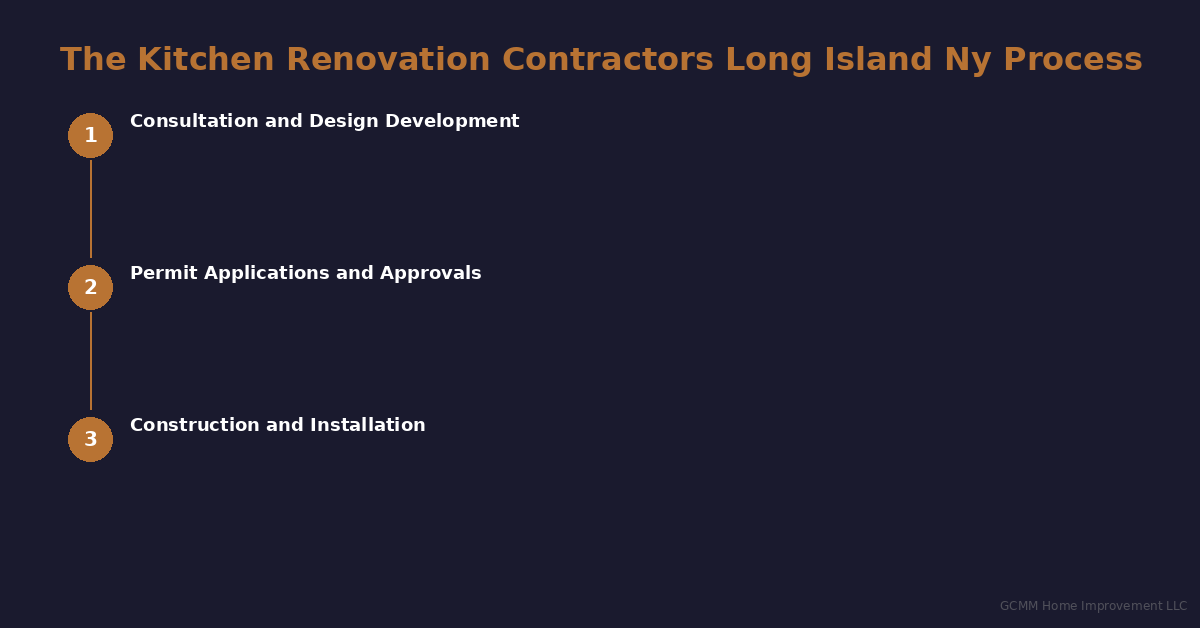
Step 1: Free In-Home Estimate and Consultation
Every project starts with a free, no-pressure in-home consultation. We visit your home, assess the existing layout, listen to your goals, take measurements, and identify any potential complications — like older plumbing that needs upgrading, load-bearing walls, or asbestos concerns in pre-1980s homes. We give you a detailed, written estimate before any work begins.
Step 2: Design and Material Selection
Once you’ve approved the estimate, we move into the design phase. This is where cabinet styles, countertop materials, flooring, hardware, and layout decisions are finalized. We work collaboratively with you to make selections that fit your aesthetic, your lifestyle, and your budget. We guide you toward materials that are durable and appropriate for how you actually use your kitchen — a family of five has very different needs than a couple who rarely cooks.
Step 3: Permits and Scheduling
For any work requiring permits, we handle the filing process on your behalf. This includes coordinating with the relevant municipal building department — whether that’s the City of Yonkers, the Town of Greenburgh, or a NYC borough. We also schedule our subcontractors (licensed plumbers, electricians) and establish a realistic project timeline that we communicate to you in writing.
Step 4: Demolition and Prep
Demolition is carefully executed, not reckless. We protect adjacent rooms with dust barriers, disconnect utilities properly before any demolition begins, and carefully identify and preserve structural elements. If your project involves opening walls for plumbing or electrical rough-in work, this phase is when that happens — and inspections occur before anything gets closed up.
Step 5: Rough-In Work (Plumbing, Electrical, HVAC)
Plumbing and electrical rough-in work is completed and inspected before any drywall goes up. This is the phase most homeowners never see but that determines how well everything functions for decades. New circuits for modern appliances, dedicated lines for the refrigerator and dishwasher, properly positioned supply and drain lines — these details matter enormously.
Step 6: Installation Phase
With rough work approved, installation begins: drywall, flooring substrate, cabinet installation, countertop templating and installation, tile backsplash, finish plumbing and electrical, appliance installation, and finish carpentry. Each trade is sequenced correctly so work doesn’t need to be undone and redone.
Step 7: Final Inspection and Walkthrough
When all work is complete, we conduct a thorough punch-list walkthrough with you before we consider the job done. Any touch-ups, adjustments, or items that don’t meet our standards are addressed immediately. We don’t close out a project until you’re genuinely satisfied.
wp:image {“id”:2306}
/wp:image
Kitchen Remodeling Services We Offer
Our team handles every aspect of a kitchen renovation — we are not a company that does only one part of the job and leaves you to manage other contractors. From the first swing of the demolition hammer to the final polish of the countertops, we coordinate the entire project under one roof.
Our kitchen renovation services include:
- Full gut kitchen renovations — complete removal and replacement of everything from floor to ceiling
- Kitchen layout reconfiguration — changing traffic flow, moving islands, expanding toward adjacent rooms
- Cabinet installation and replacement — stock, semi-custom, and fully custom cabinetry
- Countertop fabrication and installation — quartz, granite, marble, butcher block, and more
- Flooring installation — tile, hardwood, luxury vinyl plank, and engineered wood
- Backsplash tile installation — subway tile, mosaic, natural stone, and custom patterns
- Plumbing modifications — sink relocation, garbage disposal installation, pot filler installation
- Electrical upgrades — new circuits, under-cabinet lighting, recessed lighting, outlet addition
- Appliance installation — built-in refrigerators, range hoods, dishwashers, and more
- Open-concept conversions — wall removal, beam installation, structural modifications
- Window and door modifications — enlarging kitchen windows for light and views
We also specialize in luxury kitchen renovation services across Westchester NY — high-end projects featuring custom inset cabinetry, waterfall-edge stone countertops, professional-grade appliances, and bespoke storage solutions. These projects require a different level of craftsmanship and project management, and our team is fully equipped to deliver.
For homeowners in the New York metro area looking for a comprehensive renovation partner, our Westchester Kitchen Bath Renovation Contractor near Me – GCMM Home Improvement LLC page covers how we handle full kitchen and bathroom renovation projects simultaneously — a common and cost-effective approach when both spaces need work.
Cabinet Installation and Custom Cabinetry
Cabinets are the single most visually dominant element of any kitchen, and they’re also one of the most functional. Poorly installed cabinets — even beautiful ones — will cause you headaches for years: doors that don’t align, drawers that stick, boxes that aren’t level. Getting cabinet installation right requires precision, experience, and an understanding of how houses in this region settle and move over time.
We install all types of cabinetry:
- Stock cabinets — pre-manufactured in standard sizes, fastest lead time and most budget-friendly
- Semi-custom cabinets — manufactured in a wider range of sizes and finishes, best value for most full renovations
- Custom cabinets — built to exact measurements and specifications, ideal for irregular layouts and high-end projects
- Cabinet refacing — replacing doors and hardware while keeping existing box structure, for cosmetic refreshes on a budget
In older Westchester homes — colonials, Tudors, Victorians — kitchen layouts often have quirky dimensions, soffit overhangs, and ceiling height variations that make off-the-shelf cabinets a poor fit. We’ve seen this in Scarsdale, Tarrytown, and throughout the Hudson Valley corridor. Custom or semi-custom solutions are frequently the right answer, and we help homeowners understand the real cost-benefit trade-off before making that call.
For more information about cabinet options, materials, and what the installation process involves, visit our kitchen cabinet installation services in Westchester NY page.
Countertop Selection and Installation
Your countertop is the primary work surface in your kitchen — it takes more abuse than any other element in the room. The right material for your kitchen depends on how you cook, how much maintenance you’re willing to do, and what aesthetic you’re going for. We’ve installed thousands of countertops across Westchester and NYC, and we’ll give you honest, experience-based guidance rather than just pushing what’s most profitable for us.
Common Countertop Materials and What You Need to Know
- Quartz — engineered stone, non-porous, extremely durable, doesn’t require sealing. The most popular choice for kitchen renovations in our area for good reason. Brands like Cambria, Silestone, and Caesarstone offer hundreds of color options.
- Granite — natural stone, each slab unique, requires annual sealing, heat-resistant. Still a top choice for many Westchester homeowners who love its natural character.
- Marble — beautiful but high-maintenance. Marble etches and stains more easily than granite or quartz. Best suited for homeowners who understand and accept that trade-off.
- Quartzite — often confused with quartz (they’re very different). Natural stone, harder than granite, stunning appearance, requires sealing.
- Butcher block — warm, inviting, and excellent for prep surfaces. Requires oiling and more care around water. Common in farmhouse-style kitchens.
- Porcelain slab — a newer option gaining popularity. Extremely durable, large-format slabs with minimal seams, heat and scratch resistant.
Countertop installation is not just about laying the material — it involves precision templating, cutouts for sinks and cooktops, edge profile selection, seam placement planning, and proper support underneath. Done correctly, a stone countertop will last the lifetime of the kitchen. Done poorly, you’ll have cracked seams, uneven surfaces, and problems within years.
Explore all your options and learn what questions to ask in our detailed guide on countertop installation options for your kitchen renovation.
Kitchen Flooring Options and Installation
Kitchen flooring needs to handle moisture, dropped items, heavy foot traffic, and the occasional spilled sauce — while still looking great. The right flooring choice balances durability with aesthetics and fits the overall design direction of the renovation.
Here are the options we most commonly install in kitchens across Westchester and NYC:
- Porcelain tile — the workhorse of kitchen flooring. Waterproof, extremely durable, available in an enormous range of looks including realistic wood and stone patterns. Requires proper substrate prep to prevent cracking.
- Luxury vinyl plank (LVP) — waterproof, comfortable underfoot, warm appearance, highly affordable. Excellent for kitchens that open to living areas where you want a consistent look across rooms.
- Hardwood — beautiful and classic, but requires more care around moisture. Often used in kitchens that connect to hardwood living or dining areas for visual continuity. Site-finished solid hardwood allows for future refinishing.
- Engineered hardwood — dimensionally more stable than solid hardwood, better suited to the moisture variations of a kitchen environment.
- Natural stone tile — limestone, travertine, slate — stunning but requires sealing and more maintenance than porcelain. Popular in high-end Scarsdale and Bronxville renovations.
One critical detail most homeowners don’t realize: when replacing kitchen flooring during a renovation, the height of the new floor relative to adjacent rooms matters. If you’re going from a thin vinyl to a thick porcelain tile, you may create a tripping hazard at doorways or affect the installation height of your new appliances. We plan for these transitions from the beginning of the project.
wp:image {“id”:2305}
/wp:image
Plumbing and Electrical in Kitchen Remodels
Two of the most critical — and least glamorous — aspects of a kitchen renovation are the plumbing and electrical systems behind the walls and under the floors. This is where corners are most commonly cut by inexperienced contractors, and where the consequences of poor work are most severe.
Kitchen Plumbing Considerations
Even a seemingly straightforward kitchen renovation often involves plumbing work: relocating the sink, adding a pot filler above the range, installing a new garbage disposal, running a water line for the refrigerator’s ice maker, or upgrading old galvanized pipes to copper or PEX. In many older Westchester homes — particularly those built before 1970 — the existing plumbing needs evaluation before any renovation begins.
Moving a sink even a few feet means rerouting supply lines and drain lines, and drain lines must maintain proper slope (typically ¼ inch per foot) to function correctly. This sometimes requires cutting into subfloor or routing through wall cavities — work that needs to be planned carefully and executed by a licensed plumber working as part of our team.
Kitchen Electrical Upgrades
Modern kitchens require significantly more electrical capacity than kitchens built 30 or 40 years ago. Code now requires dedicated 20-amp circuits for the refrigerator, dishwasher, and microwave, plus GFCI protection for all outlets within six feet of a sink. If you’re adding a high-BTU gas range with an electric igniter, an electric cooktop, or a wall oven, additional dedicated circuits are required.
Under-cabinet LED lighting, recessed lighting on dimmers, and smart home integrations are all increasingly common in kitchen renovations we complete. We plan the entire electrical layout before the walls close, so you get exactly what you want without having to cut into finished drywall later.
All electrical work on our projects is performed or directly supervised by licensed electricians and inspected before walls are closed. This is non-negotiable, and it’s how you protect your family and your investment.
Open-Concept Kitchen Conversions
One of the most transformative renovations we perform is the open-concept conversion — removing a wall (or walls) between the kitchen and an adjacent living room, dining room, or den to create a single, flowing space. For homes built in the 1950s through the 1980s, this is often the single change that has the biggest impact on how the home feels and functions.
Opening up a kitchen to the living space improves natural light distribution, makes the home feel significantly larger, and allows whoever is cooking to remain connected to family and guests. It dramatically improves the resale appeal of the home as well — open-concept layouts are consistently the most sought-after feature in Westchester and NYC real estate listings.
However, not all walls can simply be removed. The most critical first step in any open-concept conversion is determining whether the wall in question is load-bearing. A load-bearing wall carries structural weight from above — removing it without proper structural support will cause serious damage. In these cases, a structural engineer calculates the required beam size to carry the load, and we install that beam with appropriate posts or columns integrated into the new design.
In addition to structural considerations, walls often contain electrical wiring, plumbing, and HVAC ductwork that need to be properly rerouted before demolition. Our team assesses all of these factors upfront, so there are no surprises when the project is underway.
Read our full breakdown of open-concept kitchen renovation services in Westchester — including what structural engineering involves, typical costs, and real examples from projects we’ve completed.
Homeowners in Scarsdale who are interested in transforming their kitchens will also find detailed information on our Scarsdale Kitchen Renovation Contractor – GCMM Home Improvement LLC page, including before-and-after examples specific to that community’s housing stock.
Cost Factors for Kitchen Renovation Projects
Kitchen renovation cost is one of the most common questions we receive, and we always answer it honestly: the range is wide because kitchens and scopes of work are wide. A cosmetic refresh in a small apartment kitchen in the Bronx is a fundamentally different project from a full gut renovation of a 200-square-foot chef’s kitchen in a Scarsdale Colonial. What matters is understanding what drives cost so you can make informed decisions about where to invest and where to save.
Primary Cost Drivers
- Kitchen size and layout complexity — more square footage, more materials, more labor. Unusual layouts or configurations increase both design time and installation difficulty.
- Scope of work — a cabinet refacing is a fraction of the cost of a full gut renovation. Knowing what you actually need prevents over-investing or under-investing.
- Cabinet selection — cabinetry typically represents 30–40% of a kitchen renovation budget. Stock vs. semi-custom vs. custom is the single biggest budget lever available.
- Countertop material — the spread between laminate and premium quartzite can be $3,000 to $15,000+ for the same kitchen. This is another major budget decision point.
- Appliance specifications — professional-grade appliances (Sub-Zero, Wolf, Thermador) cost significantly more than mid-grade options (Bosch, KitchenAid, Samsung) and often require upgraded electrical and ventilation systems.
- Structural modifications — wall removal, beam installation, and structural engineering add cost but are often the highest-value changes you can make to a space.
- Plumbing and electrical upgrades — if the existing systems need upgrading (old galvanized pipe, undersized panel, insufficient circuits), that cost is real and non-negotiable.
- Permit fees — permit costs vary by municipality but are typically a small percentage of total project cost. Always budget for them; skipping permits costs far more in the long run.
For a detailed breakdown of what kitchen renovations actually cost in this market, including real cost ranges for different project scopes, read our kitchen renovation cost guide for Westchester homeowners. It covers everything from entry-level refreshes to full luxury renovations, with numbers that reflect what local materials and labor actually cost in 2024–2025.
How to Plan Your Kitchen Renovation Timeline
One of the biggest sources of frustration for homeowners undertaking a kitchen renovation is timeline uncertainty. How long will you actually be without a functional kitchen? When should you start planning to be ready for the holidays? Understanding what drives timeline will help you plan realistically and avoid unnecessary stress.
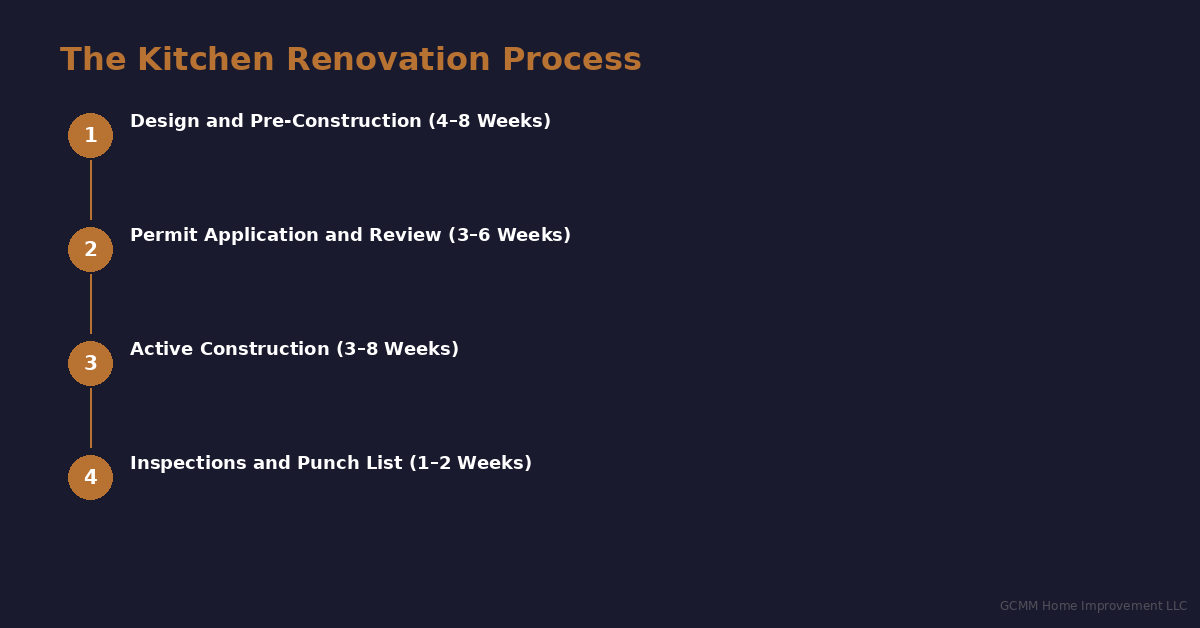
Here’s a general framework for how kitchen renovation timelines break down:
- Design and material selection: 2–6 weeks. This is often the phase that takes longer than homeowners expect. Cabinet lead times are the most common culprit — semi-custom and custom cabinets can have 4–12 week lead times from order to delivery.
- Permit approval: 1–4 weeks, depending on municipality. Some Westchester towns have faster turnaround than others. NYC permits can take longer.
- Demolition: 1–3 days for most kitchens.
- Rough-in work (plumbing, electrical): 3–7 days, plus time for inspections.
- Drywall, priming, painting: 3–5 days.
- Cabinet installation: 2–5 days, depending on kitchen size and complexity.
- Countertop templating and fabrication: Countertops can’t be templated until cabinets are installed. Fabrication typically takes 7–14 days after templating.
- Flooring, backsplash, finish work: 3–7 days.
- Final plumbing and electrical connections, appliance installation: 1–2 days.
From the start of demolition to a fully functional kitchen, a standard full renovation takes 6–10 weeks for most homes. Larger or more complex projects can run 10–14 weeks. The biggest variable is almost always material lead times — ordering cabinets early is the single most effective way to keep a project on schedule.
For a more detailed look at what affects your specific project timeline, read our guide on realistic kitchen renovation timeline and what affects it.
Service Areas Across Westchester and NYC
Based in Tarrytown, NY, GCMM Home Improvement LLC serves homeowners throughout Westchester County and into the five boroughs of New York City. We’re not a company that drives four hours to do a job — our team is local, we know the housing stock in these communities intimately, and we understand the specific building departments and permit processes in each municipality we serve.
Westchester County
We serve all of Westchester County, with particularly deep experience in the following communities:
- Yonkers, NY — Westchester’s largest city has diverse housing ranging from attached rowhomes to large single-family houses. Learn more about our kitchen remodeling services in Yonkers NY.
- White Plains, NY — the county seat, with a mix of condos, co-ops, and single-family homes. We offer complete kitchen remodeling services in White Plains NY.
- New Rochelle, NY — a mix of older homes with tremendous potential for open-concept transformations. See our kitchen remodeling in New Rochelle NY page for local project details.
- Mount Vernon, NY — older housing stock that often benefits significantly from comprehensive kitchen upgrades. Our team provides complete kitchen remodeling services in Mount Vernon NY.
- Scarsdale, NY — one of Westchester’s most prestigious communities, where high-end kitchen renovations are the norm. Our Kitchen renovation Services Westchester NY – GCMM Home Improvement LLC page covers the full range of services we deliver in this market.
- Tarrytown, NY — our home base, where we’ve renovated kitchens throughout the village and the surrounding area.
NYC Boroughs
We extend our kitchen renovation services into New York City, with regular projects across:
- The Bronx — from Co-op City to Riverdale, we handle kitchen renovation services in the Bronx NY with full knowledge of NYC building code requirements and co-op/condo board approval processes.
- Manhattan, Brooklyn, Queens, and Staten Island — we take on selected projects throughout the five boroughs, particularly for larger renovation scopes.
Not sure if we service your specific area? Call us at (347) 961-7357 and we’ll let you know right away.
Why Choose GCMM Home Improvement LLC
There’s no shortage of contractors in the New York metro area who will tell you they do kitchen renovations. What separates the best from the rest isn’t marketing — it’s how they actually perform on the job, how they communicate when problems arise, and whether the finished product holds up years after they’ve cashed the final check. Here’s what we believe sets our team apart:
20+ Years of Focused Experience
We’ve been doing this work in this market for over two decades. That experience means we’ve encountered the unusual scenarios — the hidden asbestos floor tile, the undersized electrical panel, the load-bearing wall nobody knew about — enough times that nothing catches us off guard. We plan better, troubleshoot faster, and make better recommendations because we’ve seen it all.
Family-Owned and Personally Accountable
GCMM Home Improvement LLC is a family business. When you hire us, you’re working with people who have their reputation on the line with every project — not a large corporation where your job is one of hundreds of simultaneous projects being managed anonymously. We’re reachable, responsive