
Luxury Kitchen Renovation Westchester NY – High-End Remodeling
Kitchens are the single highest-returning investment in a Westchester home — and in markets like Scarsdale, Larchmont, and Rye, a luxury kitchen renovation consistently returns 70–80% of project cost at resale while adding tens of thousands to appraised value the day it’s completed. At GCMM Home Improvement LLC, we’ve spent more than 20 years executing high-end kitchen remodels across Westchester County, and the numbers are unambiguous: homeowners who invest between $80,000 and $150,000 in a full luxury kitchen overhaul in these zip codes routinely see their asking price increase by $100,000 or more in competitive listing seasons. This page breaks down exactly what goes into a true luxury kitchen renovation — not the marketing version, the real one — and why the gap between a standard remodel and a high-end build is far wider than most homeowners realize before they start getting quotes.
What Separates a Luxury Kitchen Remodel from a Standard Renovation
The distinction isn’t just aesthetic. A standard kitchen renovation in Westchester typically involves swapping cabinet boxes, installing a prefabricated countertop, and upgrading appliances to mid-range models. The work is functional and can dramatically improve an outdated space — but it’s a fundamentally different scope than what luxury clients in Scarsdale or Larchmont are commissioning.
A true luxury kitchen renovation involves custom millwork designed and built specifically for the kitchen’s dimensions, appliances that require dedicated electrical circuits and structural reinforcement, ventilation systems that require custom ductwork routed through walls or ceilings, and countertop materials that are templated, cut, and hand-finished on-site. Every trade — electrical, plumbing, HVAC, tile, carpentry — operates on a coordinated schedule because the materials and sequencing demand it. A six-inch miscalculation in cabinet placement affects the waterfall countertop, which affects the range hood centerline, which affects the lighting plan. These projects require a general contractor who manages the full scope, not a series of disconnected subcontractors working in sequence.
Our team at GCMM serves as the single point of accountability on every luxury kitchen project. As your expert kitchen renovation contractor for luxury projects, we coordinate every trade, manage material lead times — which for custom cabinetry and stone often run 8–12 weeks — and ensure the finished product meets the standard the investment demands.
wp:image {“id”:2306}
/wp:image
Custom Cabinetry: The Structural Foundation of Every High-End Kitchen
Custom cabinetry is where the budget difference between a standard and luxury kitchen is most immediately visible — and most easily misunderstood. Semi-custom cabinets from big-box sources typically run $150–$350 per linear foot installed. Fully custom cabinetry, built to exact specifications by a skilled millwork shop, runs $500–$1,200 per linear foot depending on wood species, finish type, and interior fittings. The cost is justified by what you’re actually getting: cabinets built to your kitchen’s exact measurements rather than adapted to fit, with interior configurations designed around how you actually use the space.
In Westchester’s older Colonial and Tudor-style homes — particularly in Rye, Larchmont, and Harrison — kitchens frequently have non-standard ceiling heights, soffits, or wall angles that make semi-custom cabinetry a compromise at best. We design and source fully custom cabinet packages that account for these architectural realities, with features like soft-close drawers on full-extension undermount slides, pull-out spice towers flanking professional ranges, integrated appliance garages with outlet strips, and custom plate racks built to the exact depth of the shelving.
Finish options at the luxury level include hand-applied paint finishes with glazing, inset door construction (where the door sits flush with the face frame rather than overlaying it — a detail that is immediately visible to any trained eye), and specialty wood veneers including white oak, walnut, and rift-sawn maple. These choices add cost, but they also add decades to the cabinet’s useful life and remain in style through multiple design cycles.
Waterfall Island Countertops: Design, Engineering, and Material Selection
Waterfall edge countertops — where the stone slab continues vertically down the sides of the island to the floor — have become the signature element of luxury kitchen design in Westchester over the past decade. The visual impact is significant, but executing a waterfall correctly requires precision that separates experienced stone fabricators from standard shops.
The critical challenge is book-matching: cutting the slab so the vertical side panel is a mirror image of the horizontal surface, creating a continuous flow in the stone’s veining. Done correctly, the seam nearly disappears. Done poorly, it creates a jarring visual discontinuity that no amount of quality stone can fix. We work exclusively with fabricators who have the equipment and experience to execute book-matched waterfalls in materials including Calacatta marble, quartzite, Nero Marquina, and high-end engineered quartz.
Material selection for a luxury kitchen island also involves practical considerations. Marble, while visually spectacular, is a calcite-based material that etches on contact with acids — meaning lemon juice, wine, and tomato sauce will dull the surface over time regardless of sealing. Quartzite, which is metamorphic silica, offers a similar aesthetic with substantially greater durability. Engineered quartz products from manufacturers like Silestone, Cambria, and Caesarstone offer the most consistent patterning and the best resistance to staining, but lack the depth and movement of natural stone. Our team walks every client through these trade-offs with actual samples in their kitchen’s lighting before any material decisions are finalized.
wp:image {“id”:2305}
/wp:image
Professional-Grade Appliance Integration: Beyond “Stainless Steel Upgrade”
Installing a 48-inch dual-fuel range from Wolf, Thermador, or La Cornue is not the same project as swapping a residential range. Professional-grade appliances require dedicated 240V circuits — often multiple, depending on configuration — gas lines upgraded to accommodate higher BTU burners, and in some cases structural reinforcement of the floor beneath the appliance’s weight. A 48-inch commercial-style range can weigh 400–600 pounds. The cabinetry flanking it must be built to accommodate the appliance’s specific reveal requirements, and the countertop cutout must be templated after the appliance is positioned.
Refrigerator columns — the separate refrigerator and freezer columns offered by Sub-Zero, Thermador, and others — require precise cabinet enclosures with specific ventilation clearances. Column refrigerators are designed to be panel-ready, meaning your cabinet maker produces matching door panels that attach to the appliance fronts, creating a seamless built-in appearance. This is beautiful when executed correctly and visually disjointed when it isn’t — the tolerances are tight and the sequencing between cabinetry delivery and appliance delivery must be coordinated precisely.
Dishwasher integration follows the same logic. Panel-ready dishwashers from Miele, Bosch Benchmark, or Fisher & Paykel require cabinet panels built to exact dimensions, with the control panel hidden on the top edge of the door. Our team manages the coordination between appliance delivery schedules and cabinetry installation timelines to ensure these integrations work correctly the first time.
Custom Range Hood Design and Installation
A custom range hood is both a functional necessity and one of the most prominent design statements in a luxury kitchen. Over a professional-range, ventilation capacity is measured in CFM (cubic feet per minute), and high-BTU commercial-style ranges require 900–1,200 CFM to effectively capture heat, steam, and combustion byproducts. Achieving this airflow typically requires a 6-inch or larger duct run — which means routing ductwork through the wall or ceiling structure, coordinating with HVAC to ensure makeup air is provided (critical in tightly sealed modern homes), and potentially adding a remote blower in the attic or exterior wall to reduce noise at the hood itself.
The hood’s exterior can be fabricated from stainless steel, hand-hammered copper, plaster, or custom millwork with an integrated liner. In the Colonial and Craftsman homes prevalent in Westchester’s established neighborhoods, a painted wood hood with corbel details and integrated lighting is often the right aesthetic choice. In more contemporary kitchens — increasingly common in newer construction in White Plains and Tarrytown — a minimal stainless chimney hood or a flush-mounted ceiling vent is more appropriate. We design and build custom hood structures in-house, ensuring the proportions are correct for the kitchen’s scale rather than adapted from a standard template.
wp:image {“id”:2299}
/wp:image
Under-Cabinet Lighting: The Detail That Elevates Everything Else
Under-cabinet lighting is one of those elements that costs relatively little in the context of a full luxury renovation — typically $2,000–$5,000 for a complete system — but has an outsized impact on the finished look and daily usability. The right system illuminates the countertop work surface evenly without shadows, adds visual depth to a tile backsplash, and creates the ambient warmth that makes a kitchen feel finished rather than functional.
At the luxury level, we install hardwired LED strip systems — not plug-in puck lights — with in-wall dimmers on dedicated circuits. Color temperature matters significantly: 2700K–3000K (warm white) renders stone and wood materials most accurately and creates the most inviting atmosphere. Systems from manufacturers like Lutron allow the under-cabinet lights to be integrated into a whole-home lighting control system, so kitchen lighting scenes can be programmed and recalled with a single tap. Recessed lighting in the ceiling is planned in concert with the under-cabinet system to avoid competing light sources that create flat, shadowless illumination.
If you’re also investing in your home’s other spaces, our team applies the same level of detail to bath spaces — see our work on luxury bathroom renovation in Westchester County for reference on how we approach high-end finishes across multiple rooms in the same project.
Luxury Kitchen Renovation Investment: What Westchester Projects Actually Cost
Transparency about cost is part of how we earn trust with high-end clients before a single wall comes down. Here’s what the numbers look like in the current Westchester market:
- Upper mid-range kitchen renovation: $60,000–$80,000 — includes semi-custom cabinetry, stone countertops, professional appliance upgrades, new flooring, and updated lighting
- Full luxury renovation: $90,000–$140,000 — custom cabinetry, waterfall island, integrated professional appliances, custom hood, full electrical upgrade, custom tile work, and lighting control integration
- Ultra-luxury/custom build-out: $150,000+ — imported stone, bespoke millwork, commercial ventilation, full smart home integration, structural modifications for open concept layouts
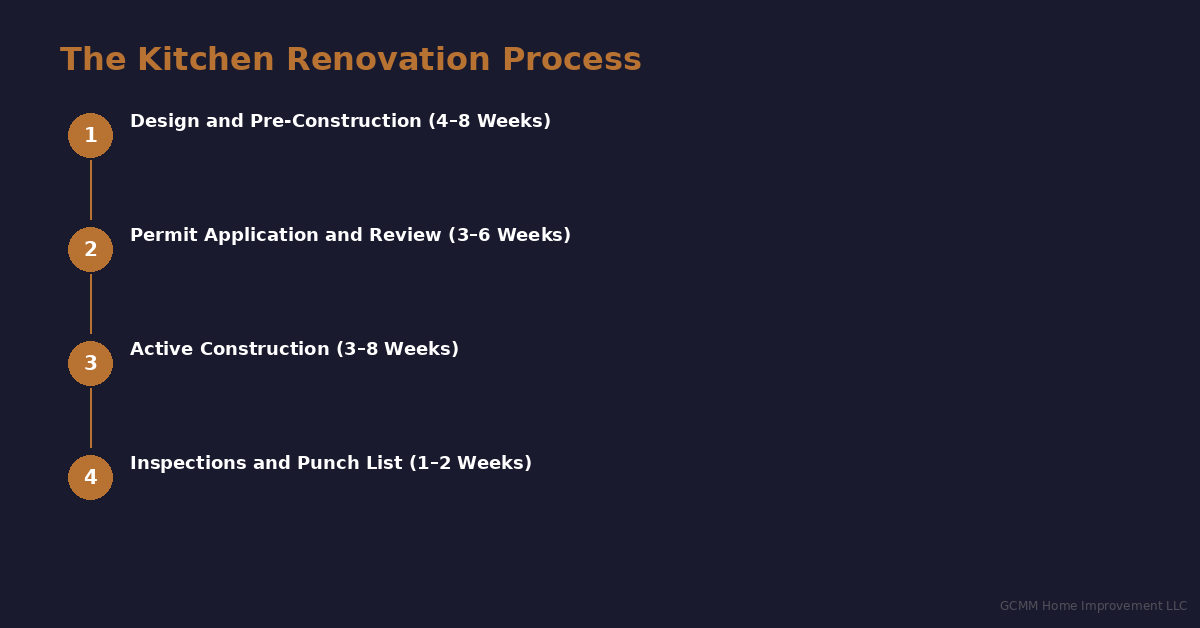
These figures reflect labor and materials in the Westchester market as of 2024–2025. Material lead times for custom cabinetry (8–14 weeks) and imported stone (4–8 weeks) mean total project timelines typically run 4–6 months from signed contract to project completion. If you want to understand how these timelines break down week by week, our kitchen renovation timeline guide walks through the full sequence in detail.
Frequently Asked Questions: Luxury Kitchen Renovation in Westchester
Do luxury kitchen renovations require permits in Westchester?
Yes — any renovation involving electrical upgrades, gas line modifications, or structural changes requires permits from your local building department. In Scarsdale, Larchmont, and Rye, permit requirements are enforced strictly, and unpermitted work creates significant liability at resale. Our team handles all permit applications and inspections as part of the project scope.
How long does a luxury kitchen renovation take from start to finish?
Realistically, 4–6 months from signed contract to final walkthrough. The design and material selection phase typically runs 6–10 weeks before demolition begins. Active construction runs 8–14 weeks depending on scope. We set accurate timelines upfront rather than optimistic ones that disappoint.
Can you work with our interior designer or architect?
Yes, and we prefer it on complex projects. We collaborate regularly with interior designers across Westchester and can coordinate directly with your design team on specifications, material lead times, and sequencing. Our role is to execute the vision with precision, not to override it.
Do you offer services in areas beyond Scarsdale and Larchmont?
We serve all of Westchester County including Rye, White Plains, New Rochelle, Mount Vernon, Yonkers, and Tarrytown, as well as the Bronx and NYC. Our base in Tarrytown puts us within 20–30 minutes of most Westchester project sites.
Start Your Luxury Kitchen Project with a Free Estimate
GCMM Home Improvement LLC is a licensed and insured, family-owned general contractor with more than 20 years of experience delivering high-end kitchen renovations across Westchester County. We offer free estimates on all projects — no pressure, no obligation, and no generic pricing ranges delivered over the phone. We visit the site, evaluate the space, discuss your vision, and provide a detailed written estimate that reflects the actual scope of work.
The same attention to detail we bring to kitchens extends to every room we touch — if you’re also considering a bathroom project, explore our approach to luxury bathroom renovation in Larchmont to see how we handle premium finishes across your home’s most important spaces.
Call us at (347) 961-7357 to schedule your free estimate. You can also reach us by email at gary@gcmm.nyc or visit our website at gcmm.nyc. Our office is located at 39 Miller Ave, Tarrytown, NY — right in the heart of the Westchester communities we’ve been serving for over two decades.
If you’re still in the early stages of planning and want to understand how to evaluate contractors before making a commitment, we recommend reading our guide on how to choose a kitchen renovation contractor — it covers the questions you should be asking every contractor you meet with, including us.