
Kitchen Countertop Installation Westchester NY — Quartz, Granite, Marble & More
Here’s a number that surprises a lot of homeowners: countertops account for roughly 10–15% of a full kitchen renovation budget, yet they’re the surface your family touches, uses, and stares at every single day. That means the material you choose — and the quality of the installation — matters more than almost any other decision in your kitchen. At GCMM Home Improvement LLC, we’ve been installing countertops in Westchester County kitchens for over 20 years, and we’ve learned that there’s no single “best” material. What’s best depends on how your family actually lives. Do you have three kids doing homework at the island after school? Are you an avid cook who’s constantly chopping, staining, and spilling? Or do you entertain regularly and want something that looks stunning on a Saturday night? Let’s break it all down so you can walk into this decision with confidence.
Quartz vs. Granite vs. Marble: Which Countertop Material Is Actually Right for You?
We get this question constantly from homeowners in Scarsdale, White Plains, and Tarrytown, and the honest answer is: it depends on your lifestyle, your budget, and your tolerance for maintenance. Here’s a real-world breakdown of each material we install most often.
Quartz — The Westchester Family Kitchen Workhorse
Quartz is engineered stone — roughly 90–95% crushed natural quartz bound with resin and pigment. Because it’s non-porous, it never needs sealing, resists bacteria growth, and handles spills from tomato sauce, red wine, and coffee without staining. For busy families in Yonkers, New Rochelle, and Mount Vernon, this is often the practical winner. Brands like Cambria, Silestone, and Caesarstone offer hundreds of colors and vein patterns that mimic the look of natural stone beautifully.
- Cost range: $70–$140 per square foot installed (material + labor)
- Durability: Excellent — resists scratching, staining, and heat (with trivets)
- Maintenance: Wipe down with soap and water. That’s it.
- Best for: Families with young kids, heavy-use kitchens, anyone who doesn’t want to think about sealing
- Watch out for: It’s not heat-proof — always use a trivet or hot pad. Direct heat from pots can discolor the resin.
Granite — Natural Beauty With Proven Staying Power
Granite has been a top choice in Westchester homes for decades, and it’s earned that reputation. Every slab is genuinely unique — the veining, movement, and color variation you see in a granite slab won’t be replicated anywhere else. It’s incredibly hard, scratch-resistant, and handles heat better than quartz. The tradeoff is maintenance: granite is porous and requires sealing once a year (sometimes every 6 months for lighter-colored stones) to prevent staining.
- Cost range: $60–$130 per square foot installed
- Durability: Excellent for heat and scratching; moderate for staining if unsealed
- Maintenance: Annual sealing plus prompt cleanup of acidic foods (citrus, wine)
- Best for: Homeowners who love natural stone character and don’t mind the yearly maintenance ritual
- Watch out for: Lighter granites (like White Ice or Colonial White) show etching faster and need more frequent sealing
Marble — Stunning, But Have an Honest Conversation First
Marble is gorgeous. There’s no denying it — Calacatta Gold or Statuario marble in a White Plains kitchen looks like it belongs in an Italian villa. But marble is also soft, porous, and highly reactive to acids. A squeeze of lemon juice left sitting for ten minutes can etch the surface permanently. We always tell our clients: if you want marble and you’re going to use your kitchen hard, you need to be okay with the patina it develops over time. Some people love that lived-in, antique look. Others find it frustrating. Know which camp you’re in before committing.
- Cost range: $75–$200+ per square foot installed depending on slab quality
- Durability: Lower than granite or quartz — susceptible to etching and staining
- Maintenance: Seal every 3–6 months, clean spills immediately, use cutting boards religiously
- Best for: Low-traffic kitchens, baking stations, homeowners who appreciate natural aging
wp:image {“id”:2305}
/wp:image
Quartzite — The “I Want Marble But Tougher” Option
Quartzite is a naturally metamorphosed sandstone that’s harder than marble and, in many cases, harder than granite. It has the dramatic veining of marble with significantly better durability. Super White and Taj Mahal are popular quartzite choices we install frequently in Scarsdale and Bronxville kitchens. Just be careful: some slabs sold as quartzite are actually soft marble or dolomite. Ask your fabricator for a hardness test. We always source our slabs carefully and can walk you through exactly what you’re getting.
- Cost range: $80–$180+ per square foot installed
- Durability: Very good — tougher than marble, comparable to granite
- Maintenance: Seal every 6–12 months; prompt spill cleanup
- Best for: Homeowners who want the look of marble with better real-world performance
Butcher Block — Warm, Practical, and More Versatile Than You Think
Butcher block gets overlooked in favor of stone, but it’s genuinely great in the right application. We often recommend it for kitchen islands, prep areas, or as an accent alongside a stone perimeter countertop. Maple and walnut are the most common species. It’s warm, forgiving on dishes, and easy to resurface if it gets beaten up over the years. It does need regular oiling (food-grade mineral oil every month or two) and you need to keep it dry — standing water will eventually warp it.
- Cost range: $40–$100 per square foot installed
- Durability: Good with proper care; can be sanded and re-oiled to refresh
- Maintenance: Monthly oiling, keep dry, avoid harsh cleaners
- Best for: Islands, baking stations, farmhouse-style kitchens, mixing materials
How the Countertop Installation Process Actually Works
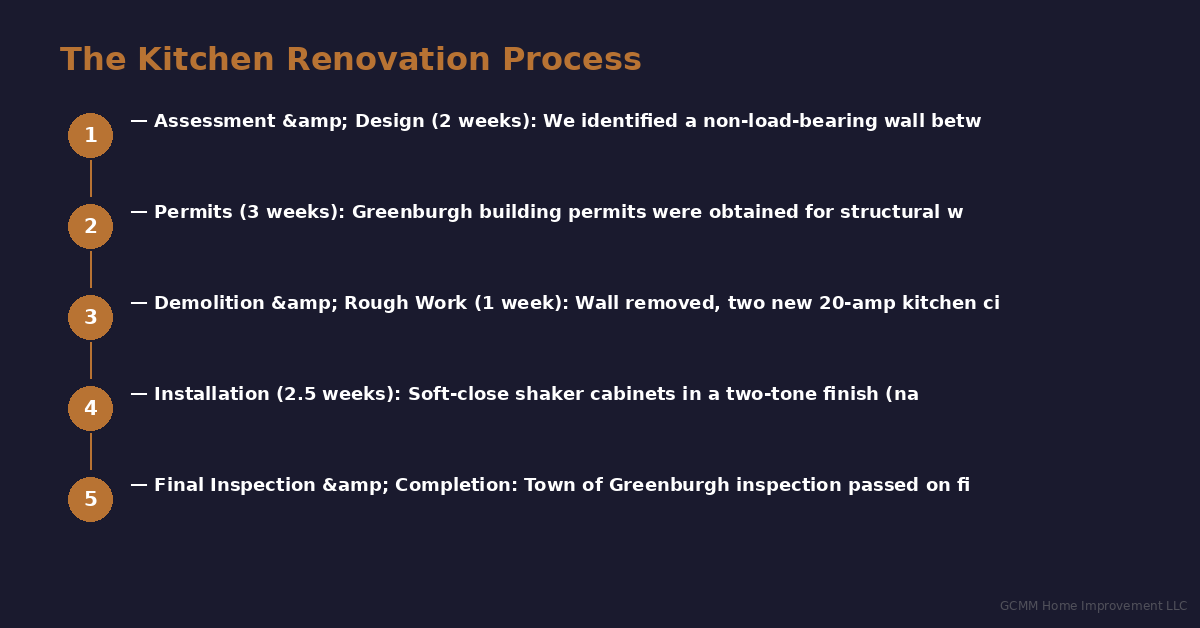
A lot of homeowners are surprised by how involved the process is — it’s not just measuring and plopping a slab down. Here’s exactly what happens when you work with our team from start to finish.
wp:image {“id”:2299}
/wp:image
Step 1: Initial Consultation and Material Selection
We start by walking through your kitchen, understanding how your family uses the space, and discussing your budget and aesthetic preferences. We’ll ask real questions: Do you cook every day? Do you have kids? Do you want something low-maintenance or are you okay putting in upkeep time? Based on that, we’ll narrow down the right material choices and give you a free, transparent estimate.
Step 2: Slab Selection
For natural stone (granite, marble, quartzite), we strongly recommend visiting the stone yard in person to select your actual slab — not just a sample chip. Natural stone varies dramatically from slab to slab. What looks like a soft gray in a sample can look almost black on a full slab, or vice versa. We guide clients through slab yards and help them visualize how the stone’s movement will lay across their specific countertop layout.
Step 3: Templating
Once your cabinets are in place (countertops always go in after cabinets), our team does a precise template of your entire countertop layout. We use digital templating tools that capture every angle, corner, sink cutout, and edge profile to the millimeter. This is one of the most important steps — a sloppy template means gaps, uneven overhangs, and cutouts that don’t fit your sink or cooktop correctly. Getting this right upfront saves significant headaches at installation.
Step 4: Fabrication
Your template goes to the fabricator, where the slab is cut to your exact specs, edges are profiled (eased, beveled, ogee, waterfall — whatever you’ve chosen), and sink cutouts are made. For most standard projects, fabrication takes 5–10 business days after templating. Premium or complex slabs may take a bit longer.
Step 5: Installation Day
This is the exciting part. Our crew carefully removes the old countertops (if this is a replacement project), makes any necessary adjustments to the cabinet bases for level installation, and sets the new countertops with construction adhesive and color-matched epoxy at seams. Seam placement is a craft — we plan seams to fall in the least visible locations and match the stone’s pattern as closely as possible. Undermount sinks are clipped and siliconed into place during this step as well.
Step 6: Sealing and Final Inspection
For natural stone, we apply the first coat of professional-grade penetrating sealer before the job is complete. We do a final walkthrough with you, check every edge, every seam, every corner, and confirm you’re happy with the result before we pack up.
wp:image {“id”:2306}
/wp:image
What Do Countertops Actually Cost in Westchester?
We’re always honest about pricing because we think homeowners deserve real numbers, not vague ranges. Here’s a realistic installed cost guide for Westchester County in 2024–2025. These figures include material, fabrication, and professional installation:
- Butcher Block: $40–$100 per sq ft
- Entry-Level Granite: $60–$85 per sq ft
- Mid-Range Granite / Standard Quartz: $85–$120 per sq ft
- Premium Quartz (Cambria, Silestone): $110–$150 per sq ft
- Quartzite: $80–$180 per sq ft
- Marble: $75–$200+ per sq ft
For an average Westchester kitchen with roughly 45–60 square feet of countertop, you’re typically looking at $3,500–$9,000 installed depending on material. Waterfall edges, complex sink cutouts, or specialty edge profiles add to the cost. If you want a more precise breakdown, our Kitchen Renovation Cost Guide for Westchester covers all the budget categories in detail.
Countertops are often just one piece of a bigger kitchen project. If you’re planning a full remodel in the area, check out our work as a Kitchen Remodeling Contractor serving White Plains — we handle everything from layout changes to cabinet installation to final finishes under one roof.
Frequently Asked Questions About Countertop Installation in Westchester
How long does a countertop installation take from start to finish?
For most projects, plan on 2–3 weeks total from initial templating to completed installation. Fabrication is the biggest variable — standard granite and quartz typically take 5–10 business days, while rare or imported slabs can take 2–3 weeks. The actual installation day is usually a full day for an average kitchen.
Can I keep using my kitchen while the countertops are being installed?
On installation day, your sink will be disconnected and your kitchen will be out of commission for the day. Most homeowners plan around it by prepping easy meals or ordering food for that evening. The following morning, everything is typically reconnected and functional.
Do I need to be home for the templating and installation appointments?
We strongly recommend you’re present for both. Templating is when edge profile choices and sink cutout dimensions get confirmed, and installation is when we do the final walkthrough. Having you there means we can answer questions in real time and make sure everything is exactly right before we leave.
Is countertop replacement always part of a full kitchen renovation, or can you just replace the countertops?
We do both. Sometimes homeowners just want to refresh their countertops without touching anything else, and that’s a perfectly sensible project. We do standalone countertop replacements throughout Westchester regularly. That said, if you’re planning a full remodel, working with an experienced kitchen renovation contractor for countertop projects and all other elements together tends to save time, money, and coordination headaches.
Do you handle the plumbing reconnection after the countertop goes in?
Yes. Our team handles the full scope — removing old countertops, installing new ones, and reconnecting your undermount sink, faucet, and plumbing. You won’t need to coordinate a separate plumber for a standard countertop swap.
Why Westchester Homeowners Choose GCMM Home Improvement LLC
We’re a family-owned company based right in Tarrytown, and we’ve been working in Westchester kitchens for over two decades. We know the older home layouts you’ll find in Bronxville and Mount Vernon. We know the larger open-plan kitchens going into new construction in Harrison and Scarsdale. We know the tight galley kitchens in Yonkers apartment buildings. That local experience matters when it comes to anticipating challenges, sourcing the right materials, and delivering installations that hold up for years.
We’re fully licensed and insured, and we give every homeowner a free, no-obligation estimate with transparent line-item pricing. No vague quotes, no surprise charges at the end of the job. And because we’re local, we’re accountable — you’re not dealing with a distant franchise that’s moved on to the next city.
If you’re also planning projects beyond the kitchen, our team handles a wide range of home improvement work — including kitchen and bath renovations throughout Westchester — so you can work with one trusted contractor for multiple scopes.
Ready to Get Started? Let’s Talk About Your Countertops.
Whether you’re replacing worn-out laminate with quartz, upgrading from basic granite to a dramatic quartzite slab, or doing a full kitchen renovation and need guidance on every material choice — we’re here to help you figure out exactly what makes sense for your kitchen and your family.
Give us a call at (347) 961-7357, shoot us an email at gary@gcmm.nyc, or visit us at 39 Miller Ave, Tarrytown, NY. We serve all of Westchester County including White Plains, Scarsdale, Yonkers, New Rochelle, Mount Vernon, and the Bronx. Free estimates, honest advice, and craftsmanship you’ll see every time you walk into your kitchen.